Permits
Do You Need a Permit for a Dumpster in Bristol?
On your own driveway, almost never. The more useful question around here is which of seventeen towns you are in, and whether your road is public.
The short answer
If your dumpster is going on your own driveway or your own private property, you almost certainly do not need a permit. That covers most of the containers we place.
If it has to sit on a public street, you will need one — and which office issues it depends on which of seventeen towns you are in.
Private property: no permit
A driveway, a private parking area, a fenced construction site, a commercial lot you own or lease — all private property, no municipal placement permit required for the container itself.
Two caveats that are not placement permits but function like them. The underlying work may need a building permit — roofing, structural, electrical, plumbing, additions and anything involving the building envelope generally do. And if the property is a rental, a condominium or has an association, their permission is not optional.
Public street: yes, permit
Placing a container in the street means occupying public right-of-way, and every town here regulates it. The permit exists for emergency access, sight lines, drainage and night-time visibility.
Our advice is always to get the container onto private property where possible. Across most of Bristol, Southington, Cheshire and the newer developments that is easy. In Plainville, the older Waterbury and Torrington neighbourhoods, and the tight village centres of Collinsville, Terryville and Litchfield borough, it is often genuinely not, and street placement needs arranging in advance.
Practical numbers for judging your own frontage: a 20 yard is twenty-two feet of container and the truck needs roughly ten more feet of clear run behind it. A 15 yard takes six feet less on the ground.
Private roads change things
Worth its own section because it surprises people, and because Bristol's own rules make the point explicitly.
The City's curbside rubbish collection covers residential properties of one to five units but specifically excludes dwellings on private roads. If your road is private, the City does not collect there — which means municipal bulk pickup is not your fallback either.
That catches a fair number of properties: some of the newer cul-de-sacs, shared drives serving several houses, and a good deal of hill-town property in Burlington, Harwinton and out toward Bethlehem.
For a container it makes no practical difference — we deliver to private roads routinely. It just means the container is the primary route rather than the backup, and it is worth knowing which situation you are in before you plan a clear-out.
Seventeen towns, three counties
Our service area spans Hartford, Litchfield and New Haven counties, and the rules change at every town line.
- Hartford County — Bristol, Plainville, Burlington, Southington, Farmington, Canton
- Litchfield County — Plymouth, Harwinton, Thomaston, Torrington, Litchfield, Bethlehem, New Hartford
- New Haven County — Wolcott, Waterbury, Cheshire, Prospect, Middlebury
Nothing about Bristol's arrangements — the free annual bulk collection, the four-foot bundling rule, the transfer station permit and its 2.5-ton threshold — applies anywhere else. Every one of these towns runs its own programme.
That is worth stating plainly because search results do not respect town lines. If you are reading about bulk pickup rules and you are not in Bristol, they are probably not your rules.
What the driveway needs to take
Not a permit question, but it is what actually stops deliveries.
A loaded roll-off concentrates several tons onto a small number of contact points. On a sound concrete or asphalt drive with boards down that is fine. On a gravel drive in the soft weeks of spring it can rut badly, and on a steep approach it can be genuinely unsafe.
We would rather have that conversation on the phone than in your driveway. There is more on surfaces and seasons here.
Overhead clearance in the hill towns
The constraint people forget entirely.
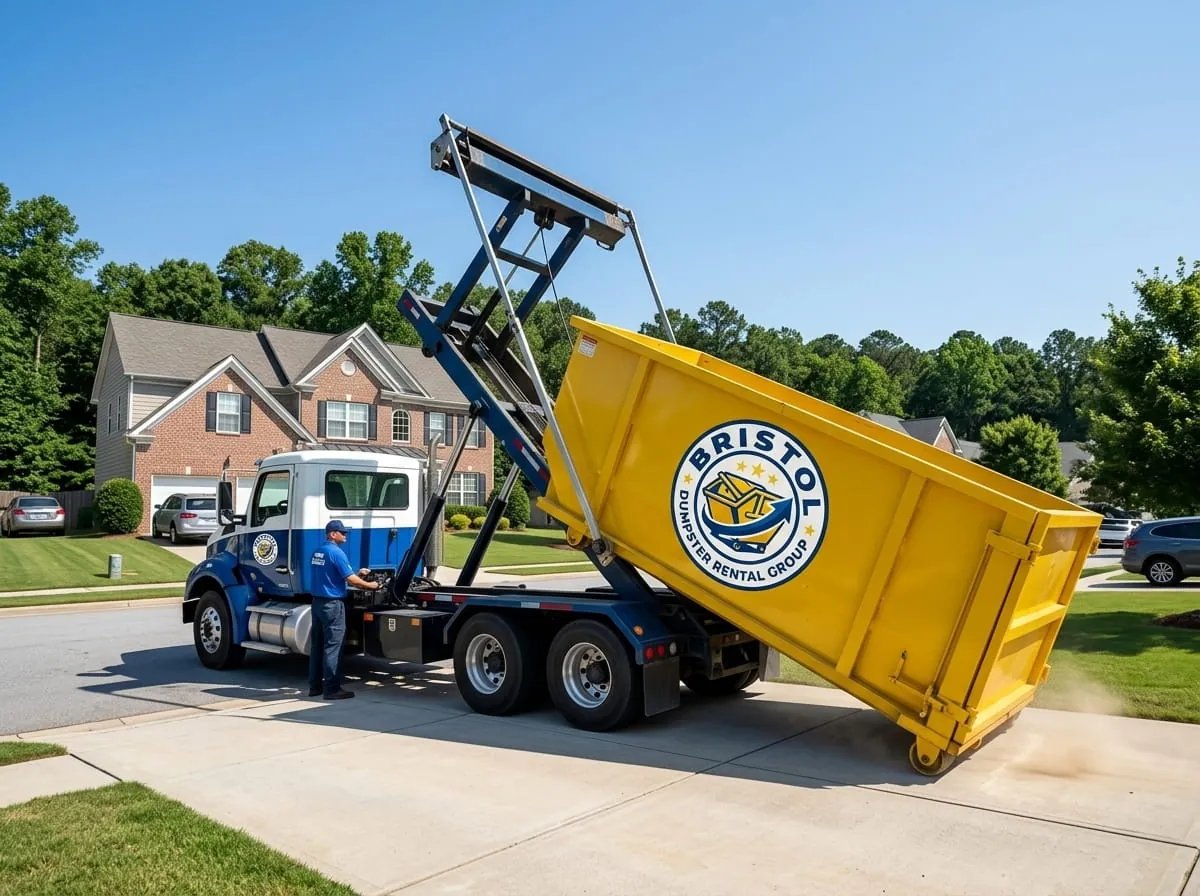
To set a container down or pick it up, the truck raises its bed to a steep angle. That needs roughly twenty-two feet of clear height above the placement and along the approach.
In Burlington, Harwinton, Litchfield, Bethlehem and New Hartford, mature canopy over a long narrow drive is the single commonest reason we have to reposition a container away from where the customer wanted it. Utility lines and low garage overhangs do the same job.
Mention branches when you book and we will plan the placement rather than discovering it on the day.
What we need from you
- Whether the container is going on private property or the street
- Which town — and whether your road is public or private
- Whether there is a landlord, condominium or association, and whether you have asked them
- Your driveway width, length, surface and grade
- Whether the underlying work is permitted
- Whether there are low branches, wires or a low overhang near the placement
If street placement turns out to be necessary, we will tell you which office to approach. We cannot pull the permit on your behalf — it attaches to the property owner or contractor — but we work across all seventeen of these towns and can make sure you ask the right one first time.
Regulations change. Everything above reflects how these towns operate at the time of writing. For anything consequential, confirm directly with your own town hall or public works department.
Need a container in Bristol?
Call and describe the job. Three minutes on the phone gets you a size recommendation, a flat rate and a delivery window — and we will tell you if a smaller, cheaper container is the right answer.
Call (860) 845-1462