
Practical
Winter, Frost and Protecting Your Driveway
Frozen ground is the best surface we work on all year. The four weeks after it lets go are the worst, and they are the ones people book into.
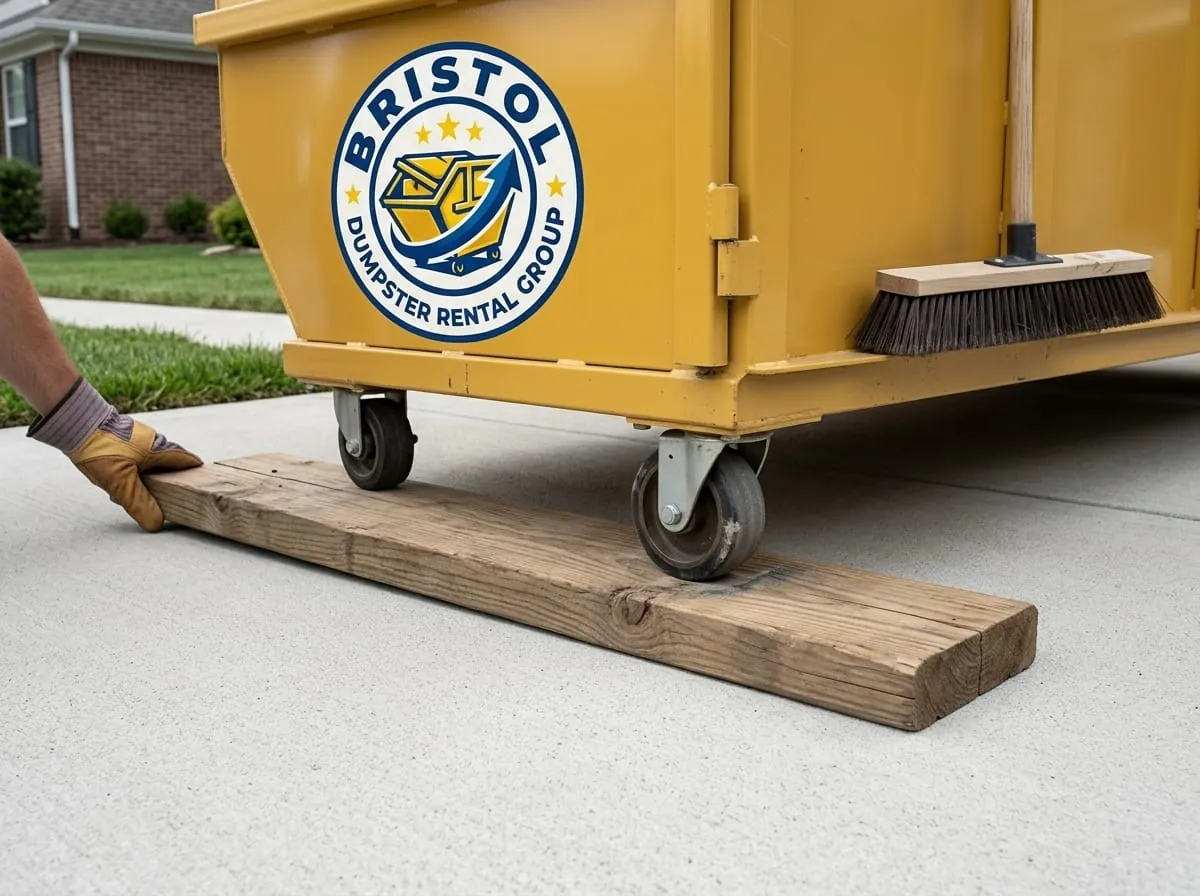
How the damage actually happens
People picture the container's weight spread across its footprint. It is not. A roll-off sits on two steel rails and concentrates load at a small number of contact points — typically the rear wheels and the front of the rails.
A 20 yard loaded to four tons, plus the container's own weight, puts something in the order of several thousand pounds onto each of those points. Three mechanisms follow:
- Static load. The container sitting there over days, gradually pressing in.
- Dynamic load during delivery. The moment the container rolls off and the rear wheels touch down is the highest instantaneous load of the whole rental.
- Dragging. Winching the container back on drags the rails across the surface.
What protection boards do
Timber or plywood under the rails spreads a point load across a much larger area. It is unglamorous and extremely effective — the difference between several thousand pounds on four small contacts and the same weight distributed across several square feet.
Our drivers carry boards on every truck as standard equipment. They go down before the container touches the surface, not afterwards, and again on collection, because the drag-on is as damaging as the drop-off.
Asphalt is the surface that benefits most in this climate. A Connecticut driveway goes through dozens of freeze-thaw cycles a year, and asphalt that has been repeatedly frozen and thawed is more brittle at the edges and softer in summer heat than it looks.
Winter is easier than you think
Counter-intuitive, but true: deeply frozen ground is the best bearing surface we get all year.
Once the ground is properly frozen, a gravel drive that would rut badly in April will carry a loaded container without a mark. Lawn and field placement that would be unthinkable in spring becomes genuinely viable. Some of our easiest hill-town deliveries happen in January.
What winter actually demands is different from what people expect:
- A cleared, plowed approach. We need to get the truck in and out, and it is a long vehicle with a low rear.
- Somewhere for the snow to go that is not where the container is sitting.
- Grit or sand on a sloped approach. Ice on a grade is the one genuine winter refusal reason.
- A tarp, because snow that lands in an open container becomes weight you pay for.
The spring thaw is the hard part
This is the season that causes actual damage, and it is short, moveable and widely underestimated.
When frozen ground releases, the top layer thaws while the ground below is still frozen solid. Meltwater cannot drain downward, so it sits in the upper layer and turns it to a saturated, unsupported mush. A gravel drive in that state has close to no bearing capacity.
Two local complications. Elevation staggers it. Torrington, Litchfield, Harwinton and Bethlehem sit several hundred feet above Bristol, hold snow noticeably longer, and thaw weeks later — so a date that suits a gravel drive in Plainville can be exactly the wrong week for the same drive up in the hills. And Connecticut towns post weight limits on some roads during the thaw for the same underlying reason.
We would rather move a booking by a fortnight than rut somebody's driveway, and we will say so when you call.
Snow load is real weight
An open container left through a snowy fortnight collects a surprising amount, and you pay for it by the ton.
Wet snow is far heavier than dry powder, and a container of absorbent debris — drywall, plaster, carpet, insulation, cardboard, timber — will hold meltwater rather than shedding it. A rain-on-snow event, which this region gets regularly, is the worst case.
A tarp between working sessions is the cheapest cost control available on a winter rental. It takes two minutes and it routinely saves more than it costs.
Surface by surface
Concrete driveway
Generally fine with boards down. Watch for existing cracking and any section that sounds hollow underfoot — a slab already cracked by frost will preferentially fail along that line.
Asphalt
The commonest driveway here and the one that most needs boards. Softens in summer heat, becomes brittle at the edges after repeated freeze-thaw, and shows a point load permanently.
Pavers and stone
Doubled boards, and we lift rather than drag. The bedding sand is the vulnerable part, not the stone.
Gravel
Excellent when frozen or dry and well compacted. Poor during the thaw and after heavy rain. This is the surface where timing matters more than technique.
Grass and bare ground
Genuinely fine when the ground is frozen hard. A bad idea in spring, and a bad idea after a wet spell.
Access, plowing and where the snow goes
Three practical things that decide whether a winter delivery works:
Tell your plow contractor. A container appearing in the middle of a plowed driveway without warning causes arguments, and a plow banking snow against a container makes it impossible for us to collect.
Plan the snow route first. Decide where the container goes and where the snow goes before delivery, not after the first storm.
Keep the approach clear on collection day. We need the same access to take it away that we needed to bring it, and a container that has been snowed in for a week takes longer to free than to load.
One more: on a long hill-town drive, a container placed at the top may be unreachable after a storm. It is sometimes worth placing nearer the road and carrying debris a little further.
If something does go wrong
It is uncommon, but it happens. Tell us straight away rather than after the container is gone. Photograph it. We are licensed and insured, and where damage results from our placement we deal with it rather than arguing about it.
What we cannot take responsibility for is damage from a hazard nobody told us about — a septic system, well, leach field, irrigation line or an oil fill line we did not know was there, or a driveway already failing that we were not shown.
The short version
- Boards go under the rails on every delivery. If a hauler does not do this as standard, use a different hauler.
- Frozen ground is good. Winter deliveries are often easier than summer ones.
- The thaw is the danger. On unpaved ground, move the date rather than the container.
- Elevation staggers the thaw by weeks. Hill-town timing is not valley timing.
- Keep it covered against snow and rain — that is weight you pay for.
- Tell your plow contractor, and plan where the snow goes.
- Tell us about septic, wells, leach fields and oil fill lines.
- Photograph existing damage before delivery.
Need a container in Bristol?
Call and describe the job. Three minutes on the phone gets you a size recommendation, a flat rate and a delivery window — and we will tell you if a smaller, cheaper container is the right answer.
Call (860) 845-1462